The Short History of a Very Confused Plant Pot

Years ago, I was watching a feel‑good segment on the local news about a garden centre that had launched a recycling scheme for their used plastic plant pots. Customers were encouraged to bring back the empties once they’d transplanted their new purchases into the garden. A wholesome little initiative, I thought.

My warm glow lasted about thirty seconds.

In my head, those pots were being returned to the supplier, washed, de‑labelled, and stacked up ready for another round of seedlings. A simple loop. A sensible loop.

But the report cut to a conveyor belt feeding perfectly good pots into a machine that crushed them into plastic pellets. The can be used to make fleece jackets!

That was the moment I realised the clue had been there all along. They never said the pots would be reused, but recycled. I’d filled in the rest with wishful thinking.

Some of the pots on that conveyor were pristine. I can understand melting down the broken ones, but a pot that’s held a plant for all of three weeks surely has a few more seasons left in it. Instead, it was being sacrificed to the great fleece‑jacket economy.

Loop the Loop!

When I was a child in the 70s and 80s, drinks came in glass bottles with a deposit. You paid a little extra, returned the empties, and got the deposit back. The bottles went back to the plant, were washed, and went straight back into circulation. No shredding. No melting. No existential questions about the global fleece surplus.

There are plans to revive that deposit‑and‑return system today and I genuinely hope they succeed. I just can’t shake the suspicion that somewhere, in a boardroom, someone is pitching the exciting potential of turning all those bottles into yet more fleece jackets.

“When it’s burning hot on summer days, she’s exactly what I need. She’s soothing like the ocean rushing on the sand. She takes care of me.”

Credits
📸 “Norfolk” by me.
🀄 Thanks to Heather and Hilde for their feedback.

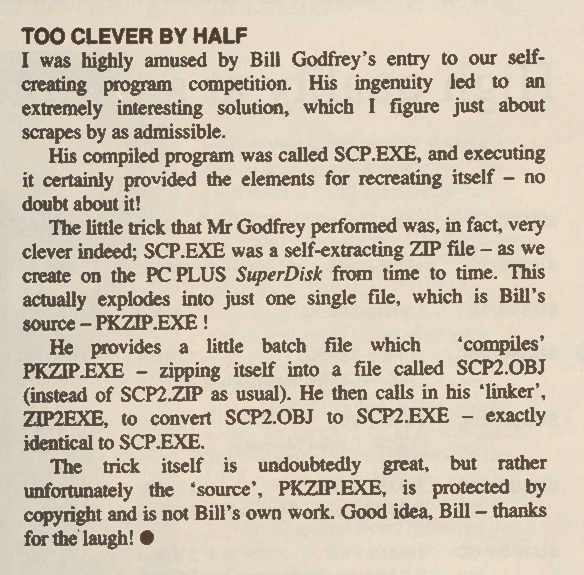
“Too Clever By Half”

Wilf’s Programmers’ Workshop, PC Plus, November, 1991.

This was my first ever publication. Wilf Hey, writer of the Programmers’ Workshop column in PC Plus, had run a contest to write what we’d now call a quine, but which he described as a “self‑creating program”, one that tells you what it does by producing its own source.

By coincidence, I had just been experimenting with PKZIP’s ability to create self‑extracting EXE files. ZIP archives fused with the decompressor into a single executable. It occurred to me that if I took a few liberties with the definition of “programming language”, I could use that mechanism to produce a rather cheeky entry.

I wrote a batch file that performed the trick, copied it onto a 3.5‑inch floppy, and posted it off.

When the issue finally came out, I was thrilled to see my name in print! I proudly showed it to all my friends in the sixth‑form lounge. But I also winced a little. I hadn’t given any thought to “source code” and he quite rightly pointed out that I wasn’t the author of PKZIP. At the time, I’d simply bundled PKZIP.EXE itself as the “source” because I needed something to be the source code and that seemed good enough. A quite inconsequential decision at the time.

After reading his comment, I started working on a revised version that included a small text file to act as the actual source. But I stopped. He wasn’t going to publish the same joke again!

Decades later, having lost my copy, I resolved to find it again. I only remembered that it must have been during my sixth-form years because I remembered the sixth-form lounge where I was showing the magazine around at school. That gave me a rough window but not the exact issue.

I got close when I discovered that archive.org had scans of Programmers’ Workshop from around that period. I found the edition that announced the quine contest, which gave me a lower bound, but none of the twenty or so scanned issues contained my entry. Still, at least I now knew which ones it wasn’t in.

Armed with the eight remaining issue dates, I posted on various retro‑computing forums to see if anyone might have a copy. A few people were selling old issues on eBay, but I wasn’t keen on paying for a one‑in‑eight chance.

What finally bore fruit was posting on Hacker News. A very helpful man, Paul Robinson, offered to go to the British Library, which holds archive copies of every issue of PC Plus, including the eight I was hunting for.

Paul’s trip to the British Library finally closed the loop. After decades of half‑memories and dead ends, there it was. My first published line of code‑adjacent mischief. Reading it again, I could see both the charm and the flaw. I’d tried to be clever, and succeeded — just not in the way the contest intended. In hindsight, the headline fits better than ever. I wasn’t just making a self‑creating program. I was being, in every sense, too clever by half.

Many thanks to archive.org, The British Library, Hacker News and Paul Robinson.

Oh yes, and congratulations to PKWare for inadvertantly writing my entry to the contest.

The Making of an Evil Genius

When I was around 9 or 10 years old, my school, as they would every year, put on a Christmas show. The younger children would re-enact the birth of Jesus of Nazareth and then the older children would perform a play. That year, we were performing Grimm’s Snow White.

I wasn’t performing on stage though. Instead, I was in charge of the music. We had a cassette of all the music and the children on stage would sing along. I would press play when its time to sing and after, position the cassette for the next song.

I wouldn’t know it at the time, but it would be this rather mundane task that taught me one of the most important lessons of my life.

A “technical hitch”

The music cassette had all the tunes with large gaps between each song. The cassette player was an early 1980s era device with a mechanical counter and a button to move all the dials back to zero. The number on the counter weren’t anything useful like seconds but how many times the motor had turned, or something like that. Fortunately for me, the teacher organising the play had gone to the trouble of writing down the counter position for each song and the order in which they are to be performed. What could go wrong?

Indeed, what could go wrong? A few days or so before the big performance,  we did a dress rehearsal and I demonstrated I could operate a cassette player without assistance. Everyone was happy.

Finally came the day of the show. Before the audience had arrived, the teacher told me to position the cassette for the first song and I did that exactly. Everything was ready. During the show, the first tune was played without a hitch and after the song was over, I dutifully positioned the cassette for the next song.

Time for the second song… disaster!

I had pressed play but instead of music, silence. I could hear the children on stage singing “We dig-dig-dig-dig-dig-dig-dig in a mine…” until they realised there was no music. The teacher duck her head behind the curtain and asked what was happening. I showed her the tape was running and I didn’t know what was wrong. She had to go up on stage and apologise for the “technical hitch”, to much laughter from the audience.

Truth is, I knew exactly what went wrong and I was already fixing it. What happened, was that when the younger children did their nativity play, their teacher was using the same cassette player for their music. When they finished, they put our cassette back in the player but the counter was all messed up. My first song was fine because the tape was already in place, but when I positioned the cassette for the second song, it was based on a counter that was in the wrong place. I had been playing one of the gaps between songs.

What’s more, I remember thinking that exactly this would happen while watching the earlier nativity play. I was sitting there thinking “I hope they put tape counter back when they finish.” But I said nothing, after all, the teachers were in control and they would have thought of this too and wouldn’t want me bothering them. I mean, they’re adults!

While I was rather mocked by the other children for spoiling an otherwise perfect performance, it turned out to be one of the most important moments of my childhood. It taught me possibly the most valuable lesson I’ve ever had.

People in authority can be wrong.

After that incident, I started looking at adults in a new light. Not just teachers, but my parents, politicians, bishops, experts, celebrities, anyone in authority. I finally saw them as the human beings we all are.

Picture credits:
“Samantha’s Christmas nativity play” by alecea on flickr.
“Soundesign tape deck” by kumar303 on flickr.
“Silence */” by circo de invierno on flickr.