“Too Clever By Half”

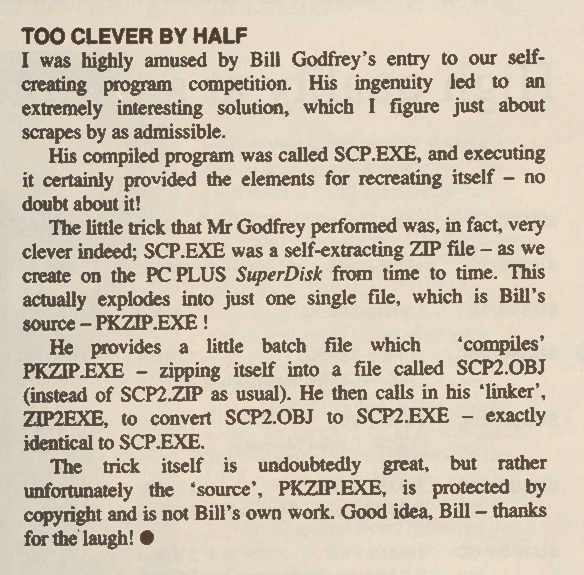
Wilf’s Programmers’ Workshop, PC Plus, November, 1991.

This was my first ever publication. Wilf Hey, writer of the Programmers’ Workshop column in PC Plus, had run a contest to write what we’d now call a quine, but which he described as a “self‑creating program”, one that tells you what it does by producing its own source.

By coincidence, I had just been experimenting with PKZIP’s ability to create self‑extracting EXE files. ZIP archives fused with the decompressor into a single executable. It occurred to me that if I took a few liberties with the definition of “programming language”, I could use that mechanism to produce a rather cheeky entry.

I wrote a batch file that performed the trick, copied it onto a 3.5‑inch floppy, and posted it off.

When the issue finally came out, I was thrilled to see my name in print! I proudly showed it to all my friends in the sixth‑form lounge. But I also winced a little. I hadn’t given any thought to “source code” and he quite rightly pointed out that I wasn’t the author of PKZIP. At the time, I’d simply bundled PKZIP.EXE itself as the “source” because I needed something to be the source code and that seemed good enough. A quite inconsequential decision at the time.

After reading his comment, I started working on a revised version that included a small text file to act as the actual source. But I stopped. He wasn’t going to publish the same joke again!

Decades later, having lost my copy, I resolved to find it again. I only remembered that it must have been during my sixth-form years because I remembered the sixth-form lounge where I was showing the magazine around at school. That gave me a rough window but not the exact issue.

I got close when I discovered that archive.org had scans of Programmers’ Workshop from around that period. I found the edition that announced the quine contest, which gave me a lower bound, but none of the twenty or so scanned issues contained my entry. Still, at least I now knew which ones it wasn’t in.

Armed with the eight remaining issue dates, I posted on various retro‑computing forums to see if anyone might have a copy. A few people were selling old issues on eBay, but I wasn’t keen on paying for a one‑in‑eight chance.

What finally bore fruit was posting on Hacker News. A very helpful man, Paul Robinson, offered to go to the British Library, which holds archive copies of every issue of PC Plus, including the eight I was hunting for.

Paul’s trip to the British Library finally closed the loop. After decades of half‑memories and dead ends, there it was. My first published line of code‑adjacent mischief. Reading it again, I could see both the charm and the flaw. I’d tried to be clever, and succeeded — just not in the way the contest intended. In hindsight, the headline fits better than ever. I wasn’t just making a self‑creating program. I was being, in every sense, too clever by half.

Many thanks to archive.org, The British Library, Hacker News and Paul Robinson.

Oh yes, and congratulations to PKWare for inadvertantly writing my entry to the contest.

Let’s All Burn Our Waste Paper!

In these environmentally conscious times, we are constantly exhorted to recycle. This is a tedious ritual involving coloured bins, soggy cardboard and the faint smell of moral superiority. Yet I submit that recycling is, in fact, the least responsible thing we could do with our waste paper.

Instead, I propose a bold, innovative, and unquestionably sustainable alternative.

Burn it. All of it. Immediately. Preferably with gusto.

“But burning paper releases CO₂!” you cry. But here is the true genius of the plan.

Once we stop recycling paper, industries that rely on recycled pulp will face a sudden, catastrophic shortage. Their only recourse will be to turn to lumber mills for virgin fibre. Lumber mills, in turn, will be forced to plant vast new forests to meet this demand. All that CO₂ we released earlier will be taken up by all those newly planted trees and taken out of the atmosphere!

Compare that to recycling paper. Send slow-moving fossil-fuel burning trucks to everyone’s house to pick up waste paper. Pulp it, bleach it and flatten it and you’ve got recycled paper that’s not quite as good as wood paper. Why not cut out the middleman and let nature grow the wood for us?

By burning paper, we create a powerful economic incentive for growing more trees, bigger forests and a greener planet. In short, every time you set fire to a stack of old utility bills, you are personally contributing to reforestation.

Furthermore, the lumber industry will enjoy a renaissance. Rural economies will flourish. Entire regions will be revitalised by the sudden need to plant millions of trees to replace the ones being fed into the paper mills at industrial speed.

🔥 Imagine the community cohesion created by weekly neighbourhood paper bonfires.
🔥Imagine the joy of watching junk mail fulfil its highest purpose.
🔥Imagine the catharsis of consigning tax forms to cleansing flame.

Recycling never gave anyone that. ♻️

“Daisy’s bare naked, I was distraught. He loves me not, he loves me not. Penny’s unlucky. I took him back and then stepped on a crack and the black cat laughed.”

But seriously…

Yes, I am joking, but only a little bit.

I had the idea when I was reminded of a TV advert from some years ago from a toilet paper company. Their bold promise was that for every tree they used to make toilet paper, they would replant three. Sounds good, but I had a slightly more cynical rewording of that slogan. “We’ve taken steps to secure the future supply of the raw materials we need.”

I mean, those three trees they planted are going to end up being cut down and turned into more toilet paper, right?

But I can’t be really cynical about toilet paper manufacturing. Even if you apply maximum cynicism, the worst I could say is that their industry is neutral. They grow trees which take carbon out of the air, but then they turn those trees into toilet paper which gets used and decomposes, releasing that carbon. Which then becomes more trees. The circle of life.

And honestly, I could hope to be neutral too. I buy potatoes, made from carbon that was taken out of the air, but then I cook and eat those potatoes which means that carbon ends up in the air again. The paper industry has more in common with a potato farmer than a plastic factory. Agriculture, even at industrial scale, is the application of the natural carbon cycle.

Recycling plastic and metals make sense, but recycling paper? Sure, I’m going to keep dropping my cardboard packaging into the recycling bin, but if I were to suggest we should recycle potatoes after we eat them, you’d call me insane. (And I must apologise for the disgusting image I put in your head just now.)

The real issue isn’t how many trees we plant, but what we do with them. Cutting down a tree and planting three saplings doesn’t remove carbon from the atmosphere; it just keeps the short carbon cycle spinning. If we actually want to lower atmospheric CO₂, we need trees that grow, mature, and stay standing. Planting three trees only matters if at least some of them are allowed to become forests rather than future toilet rolls.

And if that means lighting the odd ceremonial blaze in the name of carbon sequestration, well, that’s just responsible citizenship.

Credits
📸 “Bonfire” by Jonas Bengtsson. (Creative Commons.)
📸 “Cat on Laptop” by Doug Woods. (Creative Commons)

Thanks to my sis and sis-in-law Heather and Hilde for their insightful review. Thanks also to The YIMBY Pod for the inspiration to write this.